Blog · September 6, 2026 · 10 min read
How to Price Custom Cabinets: A Real $11,365 Kitchen Bid
By the Amberdesk team
Every page about how to price custom cabinets gives you a range. $300 to $750 a linear foot. $10,000 to $40,000 a kitchen. Then a list of "factors": wood species, door style, hardware tier, your zip code.
A range is what you tell a homeowner on the phone. It's not how a shop prices a kitchen.
So we priced one. A full shaker kitchen, 6 uppers and 7 base units with a pantry and a lazy susan, quartz counters, built in Amberdesk box by box: 74 calculated lines, 8 cabinet assemblies, $11,365.20. It's a demo shop's book, so the numbers are realistic fixture data rather than a customer's job. But the estimating engine computed every figure below. We typed none of them.
Here's some of what fell out. The countertop sub costs more than every sheet of plywood, board foot of oak, hinge and pull in the kitchen combined. All 13 boxes are 37% of the bid. And the only thing above cost in the whole estimate is a 10% contingency, which is not a margin. Step 5 shows why.
You'll see where all $11,365.20 goes, then the 7 steps that produced it: the box recipe, waste, hours, the counter, the margin decision, the cheaper kitchen and the upgrade.
Money first.
Where $11,365.20 actually goes
Here's the kitchen, split the way the engine splits it:
| Cost type | Amount | Share of cost of work |
|---|---|---|
| Labor | $3,549.25 | 34.4% |
| Subcontractors | $3,382.00 | 32.7% |
| Materials | $2,950.75 | 28.6% |
| Equipment | $300.00 | 2.9% |
| Fees | $150.00 | 1.5% |
| Cost of work | $10,332.00 | |
| Contingency (10%) | $1,033.20 | |
| Total | $11,365.20 |
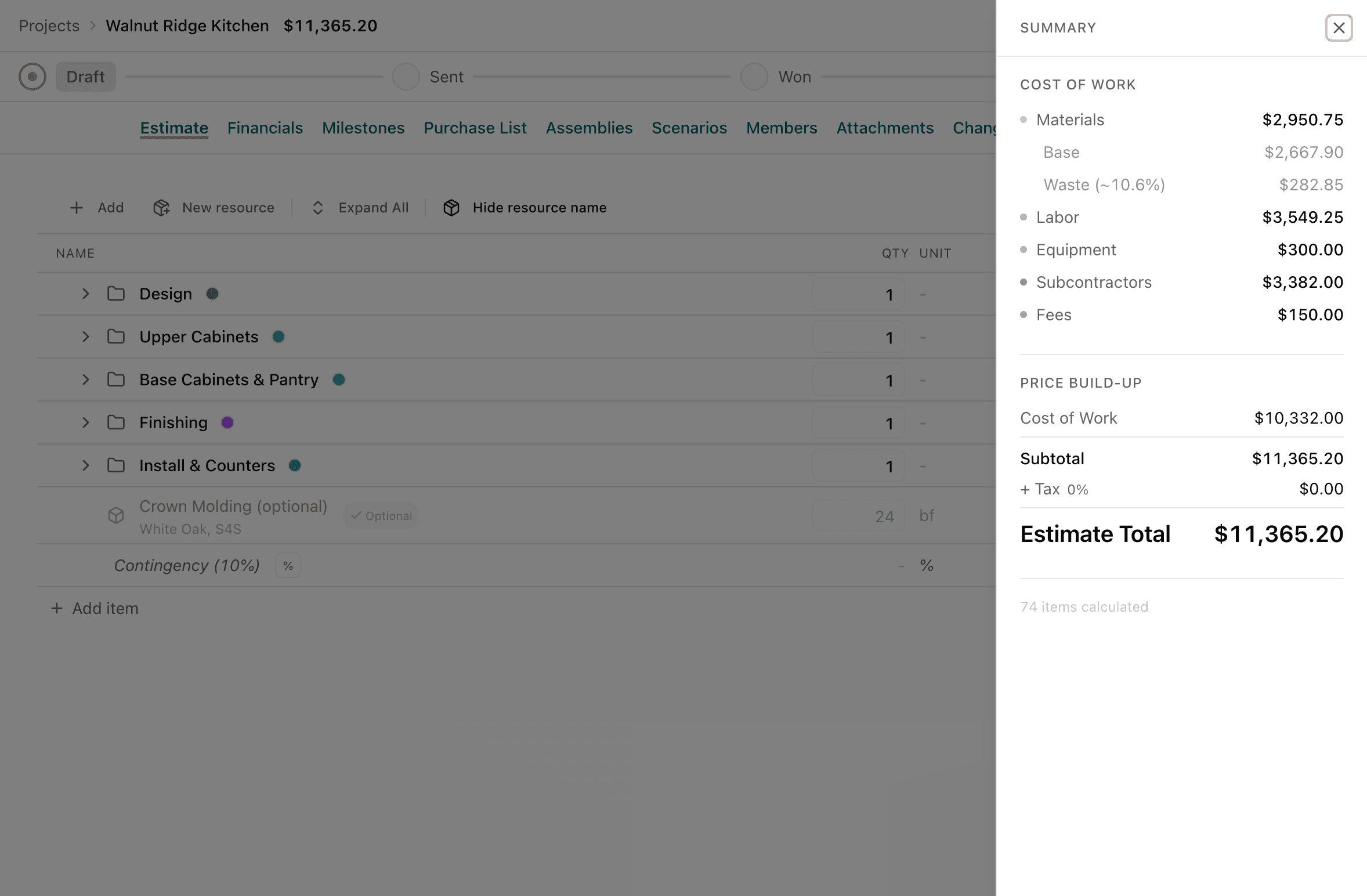
Now the numbers a "factors that affect cabinet prices" list never shows you:
- The counter beats the cabinets' materials. Quartz fab and install: $3,230.00. Every material in the kitchen (21.5 sheets of birch ply, 68 board feet of white oak, 36 hinges, 21 pulls and 4.5 gallons of lacquer): $2,950.75.
- Thirteen boxes are 37% of the bid. Uppers $1,408.37, bases and pantry $2,780.83. That's $4,189.20, or $322.25 a box. Design, finishing, install, the counter and the contingency take the other 63%.
- Per linear foot, since someone will ask: about 32.5 feet of cabinet (counting the corner unit as 36 inches) makes this $349.70 a foot for the whole job and $128.90 a foot for the boxes alone. Both sit under the $300 to $750 a foot AS Estimation quotes for custom work, because this kitchen carries no markup. Hold that thought until step 5.
- 45.75 hours. Design 6, assembly 16.2, finishing 7.55, install 16. That's 1.83 shop hours per box before anyone drives to the site.
Here's how the estimate was built.
1. Price the box once, sell it thirteen times
A cabinet is a recipe: sheets, board feet, banding, hinges, a pull, assembly hours, finishing hours. Write the recipe once and the kitchen becomes a count.
This is the recipe for a 24-inch wall cabinet:
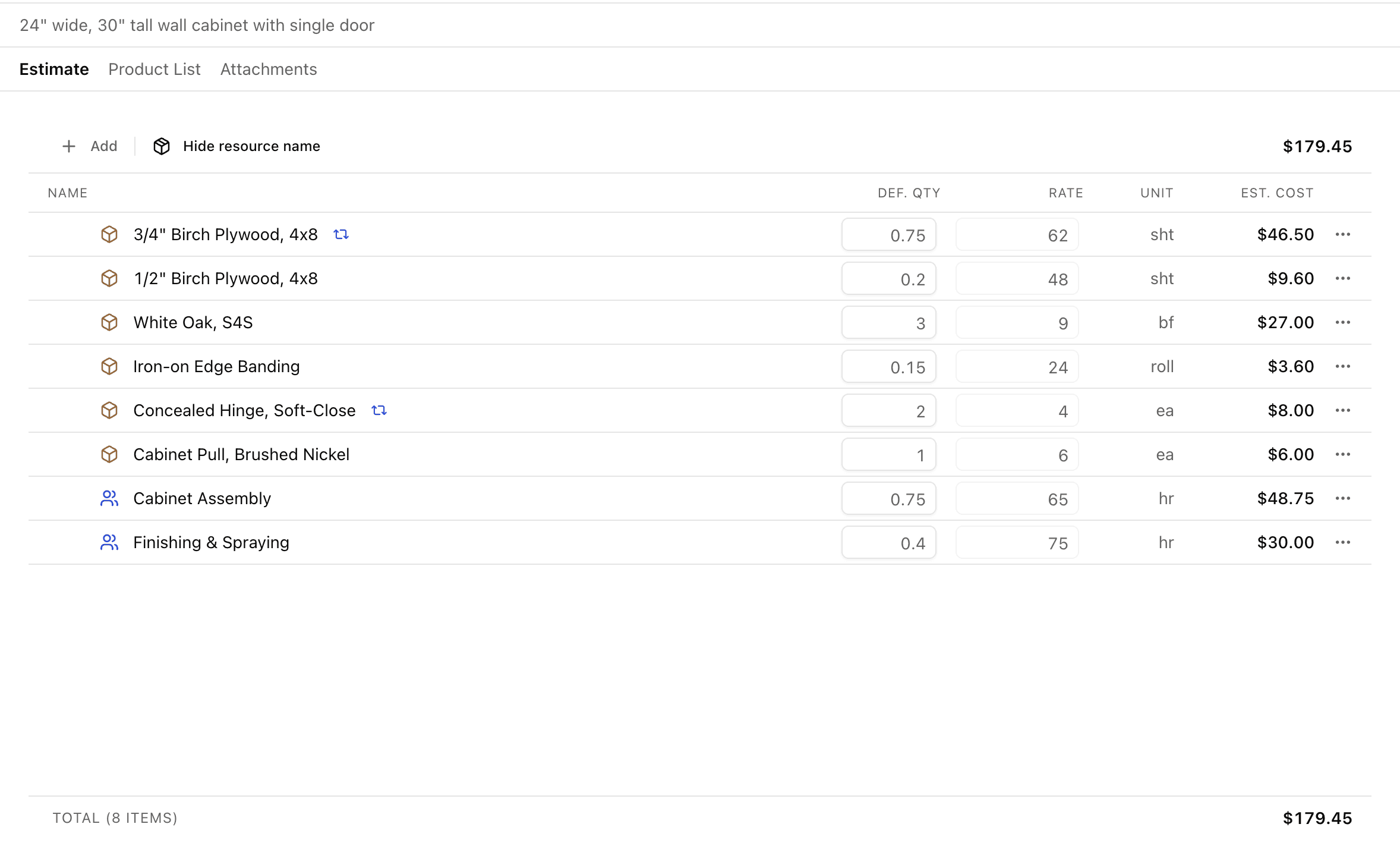
Eight lines, $179.45 at catalog cost. The biggest line is three-quarters of a sheet of 3/4" birch, $46.50. The two soft-close hinges: $8.
In the kitchen estimate that recipe is one row, quantity 2, $380.20, and the whole Upper Cabinets group is three rows:
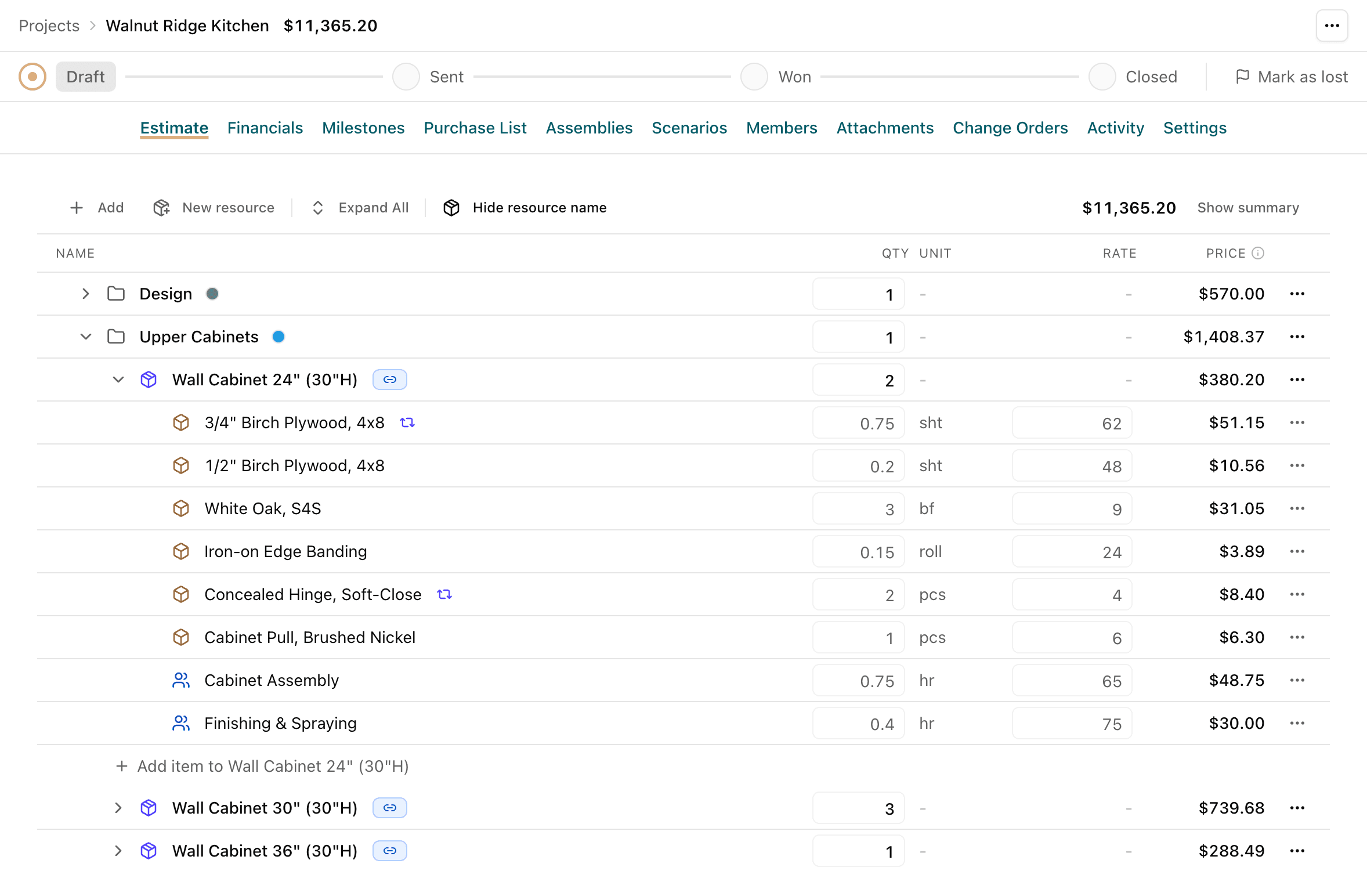
Six uppers and seven bases came from 8 assemblies. Nobody typed "concealed hinge, soft-close" thirteen times. When the shop's hinge price moves, the assembly moves, and so does every kitchen after it.
How to do it:
- Build one assembly per cabinet type you build, by width and by kind: wall, base, drawer base, sink base, corner, tall. This shop has 12.
- Put everything in the recipe, down to the 0.15 roll of edge banding and the 0.4 hours of spray time. Small lines are where a “per box” price quietly leaks.
- In the estimate, insert the assembly and set the quantity. Change the count, not the lines.
2. Put the waste in the sheet, not in the guess
Waste belongs on the material, in the catalog, once. Not as "I'll add 10% at the end," which you'll forget, and not as a padded quantity in the assembly, which nobody will remember later.
Here's the 3/4" birch in this shop's catalog:
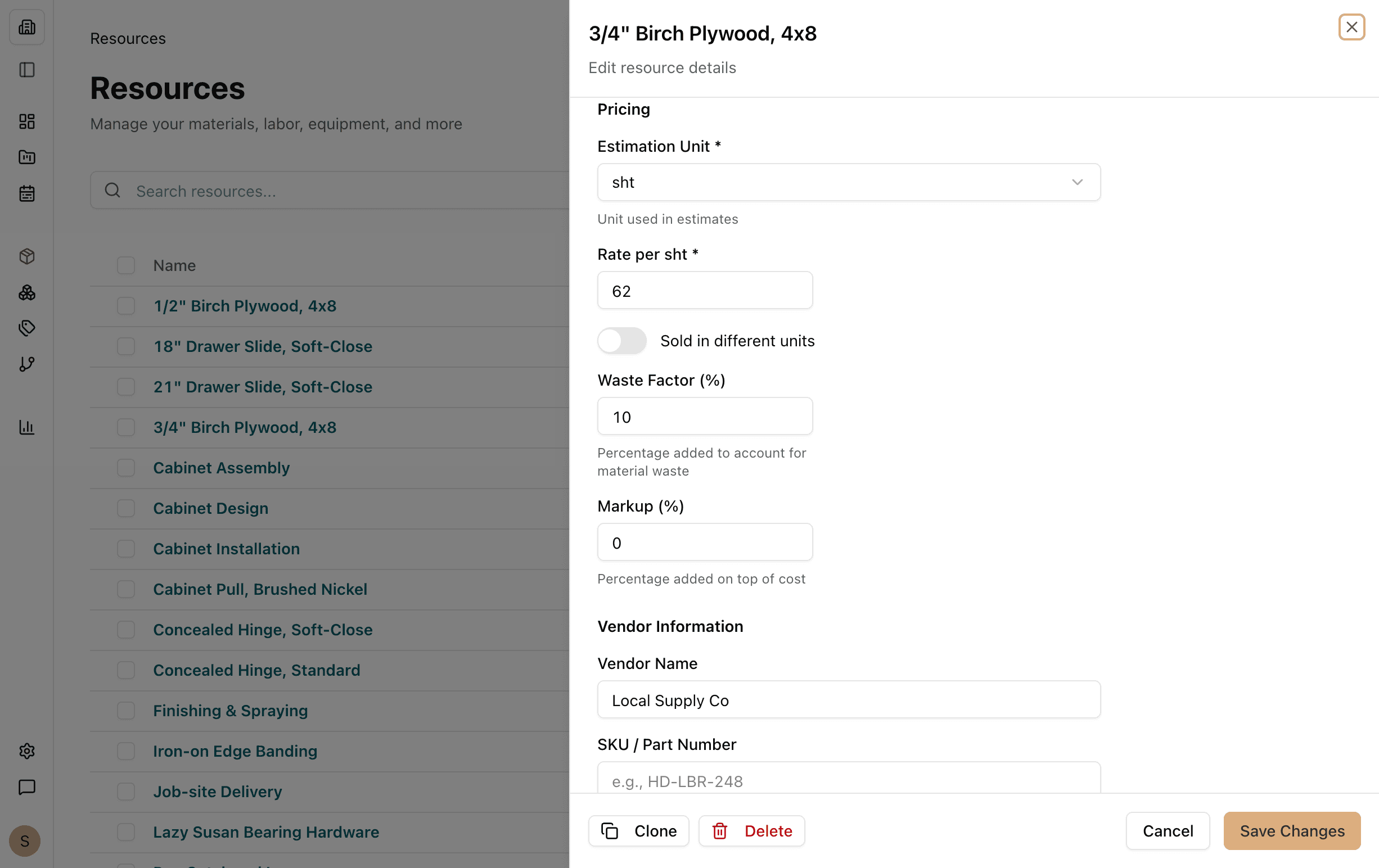
$62 a sheet, 10% waste and, look at it, 0% markup. Every material carries its own factor: 15% on the white oak (defects and grain matching cost more), 12% on the lacquer, 5% on hinges and pulls.
The engine applies the factor on every line that uses the material, so the purchase list already says what to buy:
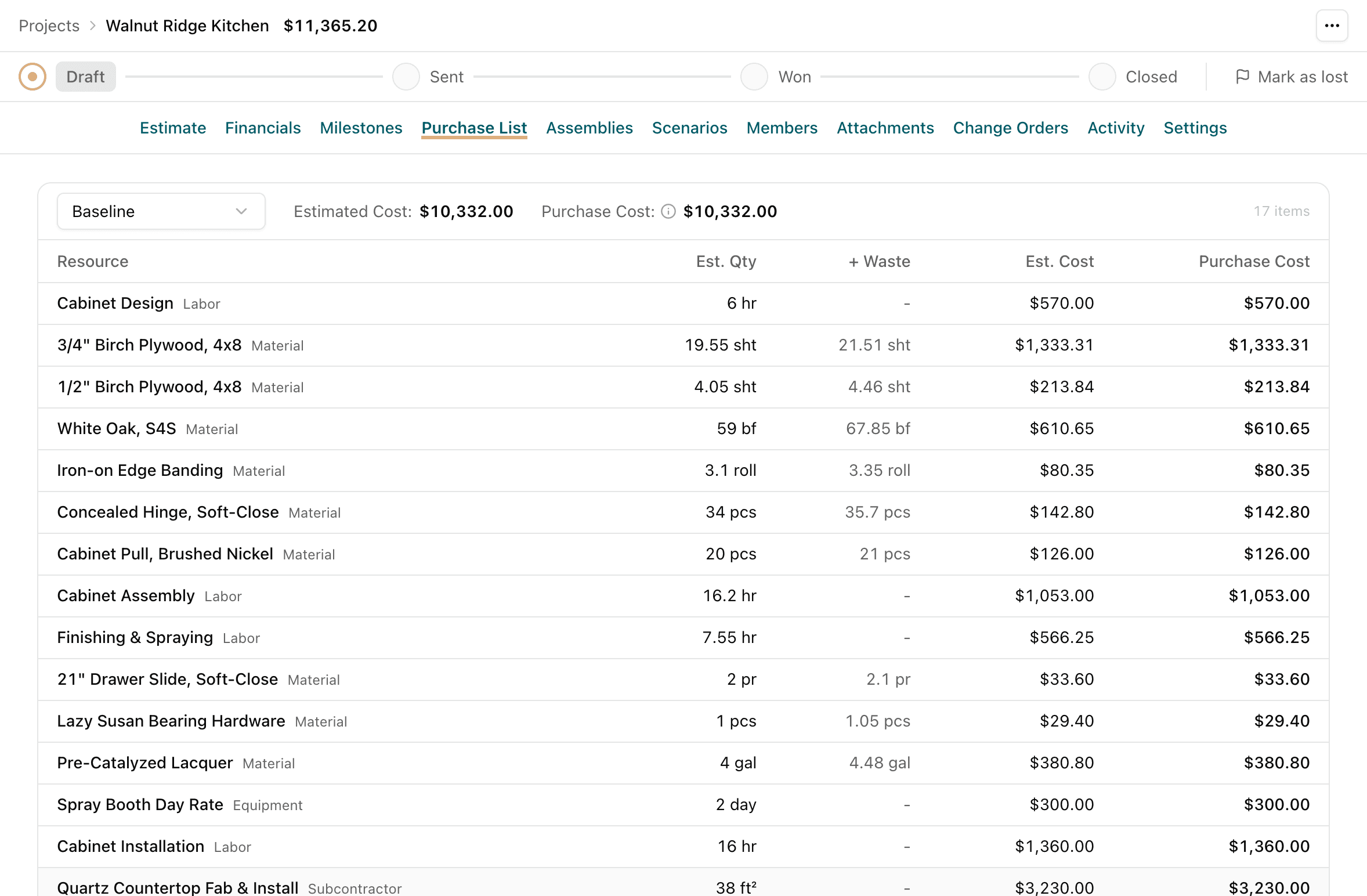
You cut 19.55 sheets of 3/4" birch. You buy 21.5. You mill 59 board feet of oak. You buy 68. This kitchen carries $282.85 of waste, about 10.6% of the material base, and nobody did that arithmetic at 11pm.
How to do it:
- Give every material a waste factor, from your offcut pile rather than a rule of thumb. Sheet goods 10%, solid hardwood 15%, finish 12%, hardware 5% is where this shop landed.
- Leave waste off labor, equipment and subs. Hours don't have offcuts.
- Order from the purchase list, not the estimate. The estimate says 19.55; the list says 21.51.
3. Count the hours by stage
Labor is the biggest number in this kitchen ($3,549.25, 34% of the cost of work), and it comes in four rates because a shop doesn't have one kind of hour.
| Stage | Hours | Rate | Amount |
|---|---|---|---|
| Cabinet Design | 6.0 | $95 | $570.00 |
| Cabinet Assembly | 16.2 | $65 | $1,053.00 |
| Finishing & Spraying | 7.55 | $75 | $566.25 |
| Cabinet Installation | 16.0 | $85 | $1,360.00 |
| Total | 45.75 | $3,549.25 |
Nobody typed the assembly and finishing hours into the estimate. They live in the recipes: 0.75 hours to build a 24" wall cabinet, 0.4 to finish it, 2 hours to build the pantry, 2.25 for the lazy susan corner. Thirteen boxes add up to 23.75 shop hours, and the engine did the adding.
Design and install are job-level lines with their own rates: 6 hours of design at $95, 16 hours of install at $85. Two people, two days, on site.
How to do it:
- One labor resource per kind of hour, each with its own rate. Design, shop, finishing and install don't cost the same, so don't average them.
- Shop hours go in the assembly. Site hours go in the estimate.
- Read the purchase list for the total. 45.75 hours is your schedule, not just your price.
4. The counter is not your cabinet
The single biggest line in this kitchen isn't a cabinet. It's 38 square feet of quartz at $85 a foot, $3,230.00, fabricated and installed by someone else.
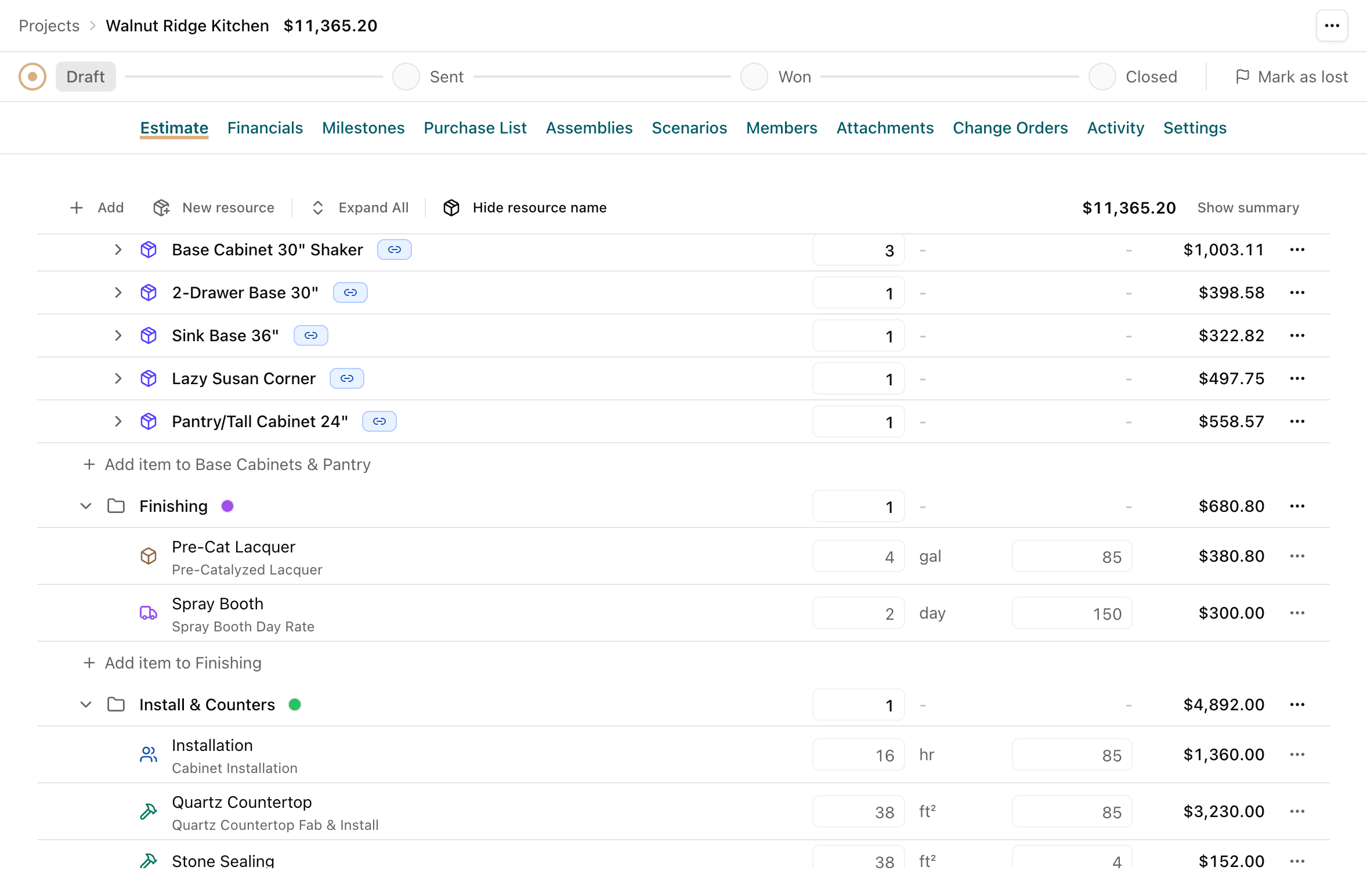
With $152 of sealing, subs come to $3,382.00: 32.7% of the cost of work, a third of the kitchen you don't build. It sits in the same estimate as the plywood because the client is buying a kitchen, not a set of boxes and a separate stone problem.
The same group holds the $300 of spray-booth days and the $150 delivery fee. Equipment and fees are small here (4.4% together), which is why they get forgotten.
How to do it:
- Keep subs, equipment and fees as their own resource types. The summary panel then shows what you build against what you buy.
- Price the sub line at what the sub charges you. What you add on top is the next step.
- Put install, counters and delivery in one group at the end. It's the part of the job that happens in someone's house, and the part clients ask about.
5. A contingency is not a margin
Here's the uncomfortable number. Cost of work: $10,332.00. Price: $11,365.20. The gap is a 10% contingency line, and nothing else.
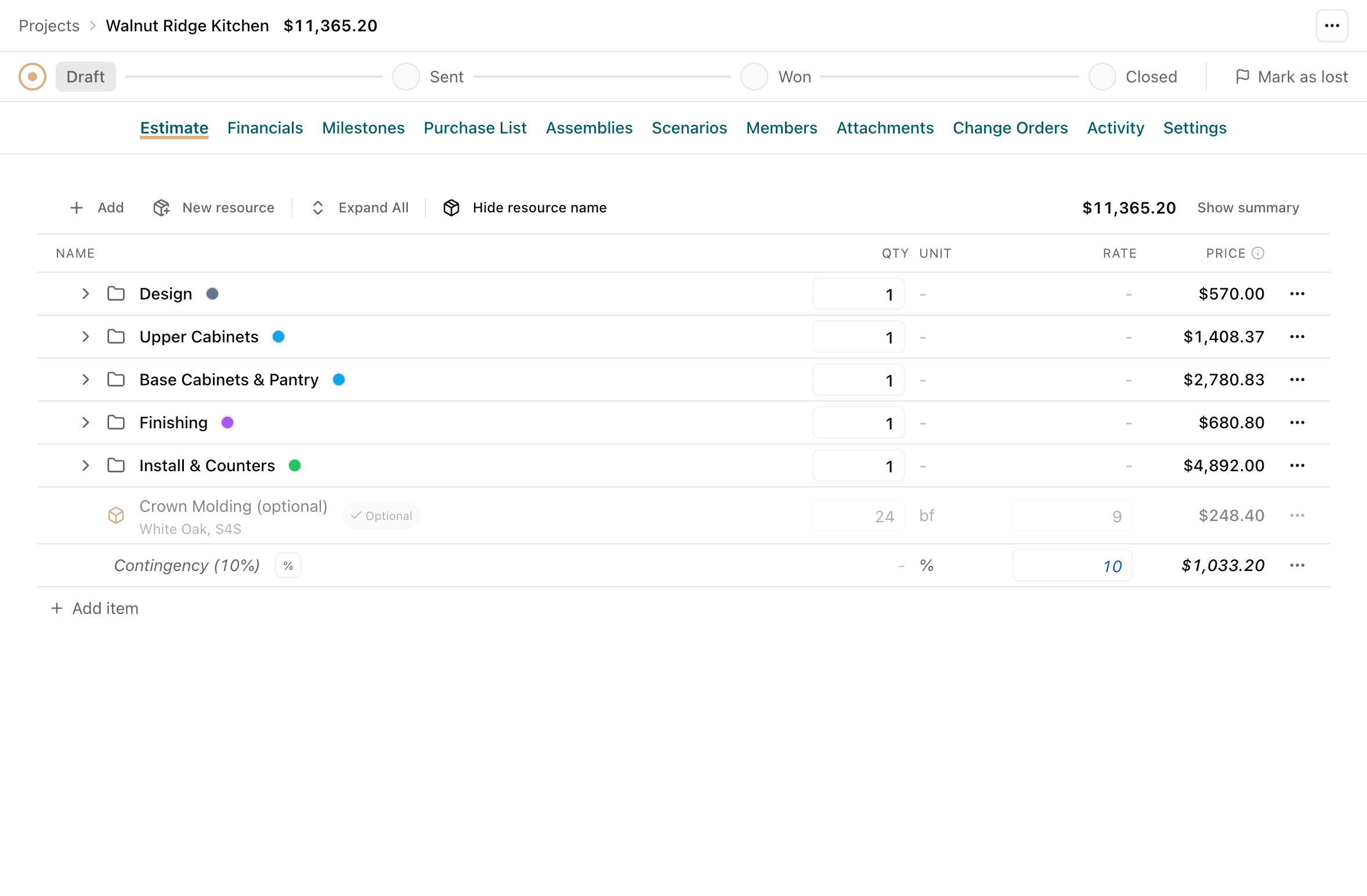
Every resource in this catalog has markup 0%. So the $1,033.20 above cost pays for the sheet that splits, the hinge order that comes up short, the extra site visit. If none of that happens, it's the profit: 9.1% of the price. That's not a margin. That's a cushion with a hopeful name.
A shop that wants a 25% gross margin on this kitchen bills about $13,776, or $2,411 more than the bid. That's our arithmetic, not the engine's, because this estimate never asked for it. Margin and markup aren't the same number, either: 25% margin is a 33% markup, and our markup vs margin calculator does the conversion.
How to do it:
- Put markup on the resource, in the catalog, so it rides every line the way waste does. Different types can carry different rates: shop labor higher than a pass-through sub.
- Keep contingency as a separate line and call it what it is. Money you plan to spend isn't profit.
- Check the summary panel before you send. “Cost of Work” against “Subtotal” is your gross margin in two lines.
6. Price the cheaper kitchen before they ask
The client will ask what it costs to come down. This kitchen already knows: $409.72.
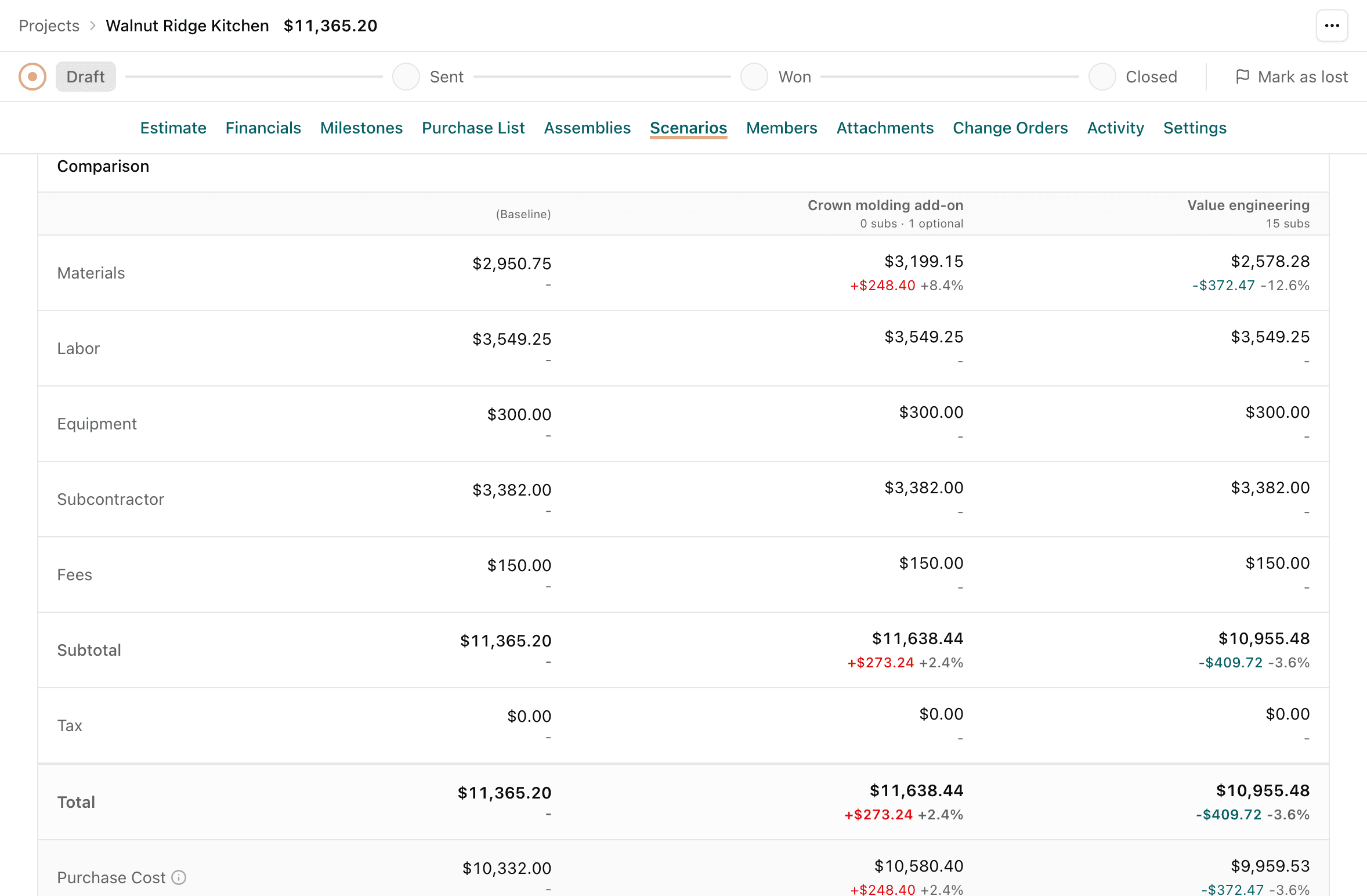
The "Value engineering" scenario swaps two things: 1/2" boxes for 3/4" ($48 a sheet instead of $62) and standard hinges for soft-close ($2 instead of $4). Two swaps, 15 substitutions across the assemblies, materials down 12.6%, total down 3.6%.
That's the number to have ready. Not "we could probably save you a few hundred," but "$409.72, and you'll feel the hinges every day."
How to do it:
- Set up alternate groups in the catalog for the choices clients make: box material, hinge type, door species, slide grade.
- Put the default in the assembly, so one swap reaches every cabinet that uses it.
- Build one scenario per option and read the comparison. The base estimate never changes.
7. Make the upgrade an option, not a new quote
The opposite question, "what would crown molding add?", gets the same shape of answer: a number, on the same document.
Crown molding is an optional line in this estimate: 24 board feet of white oak, $248.40, left out of the total until someone says yes. When the shop exports the proposal, it prints under "Optional add-ons," and the two scenarios print under "Project options."
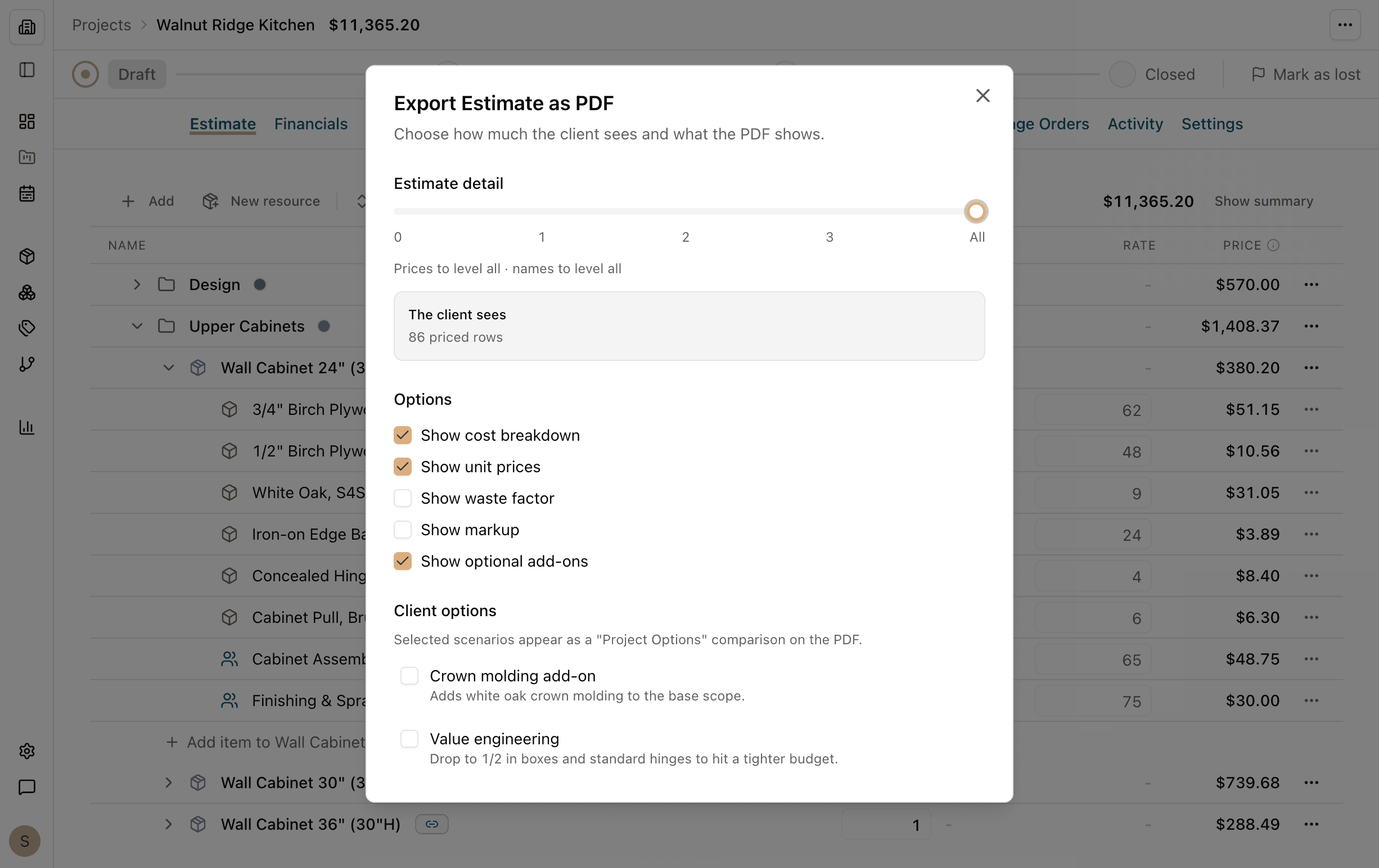
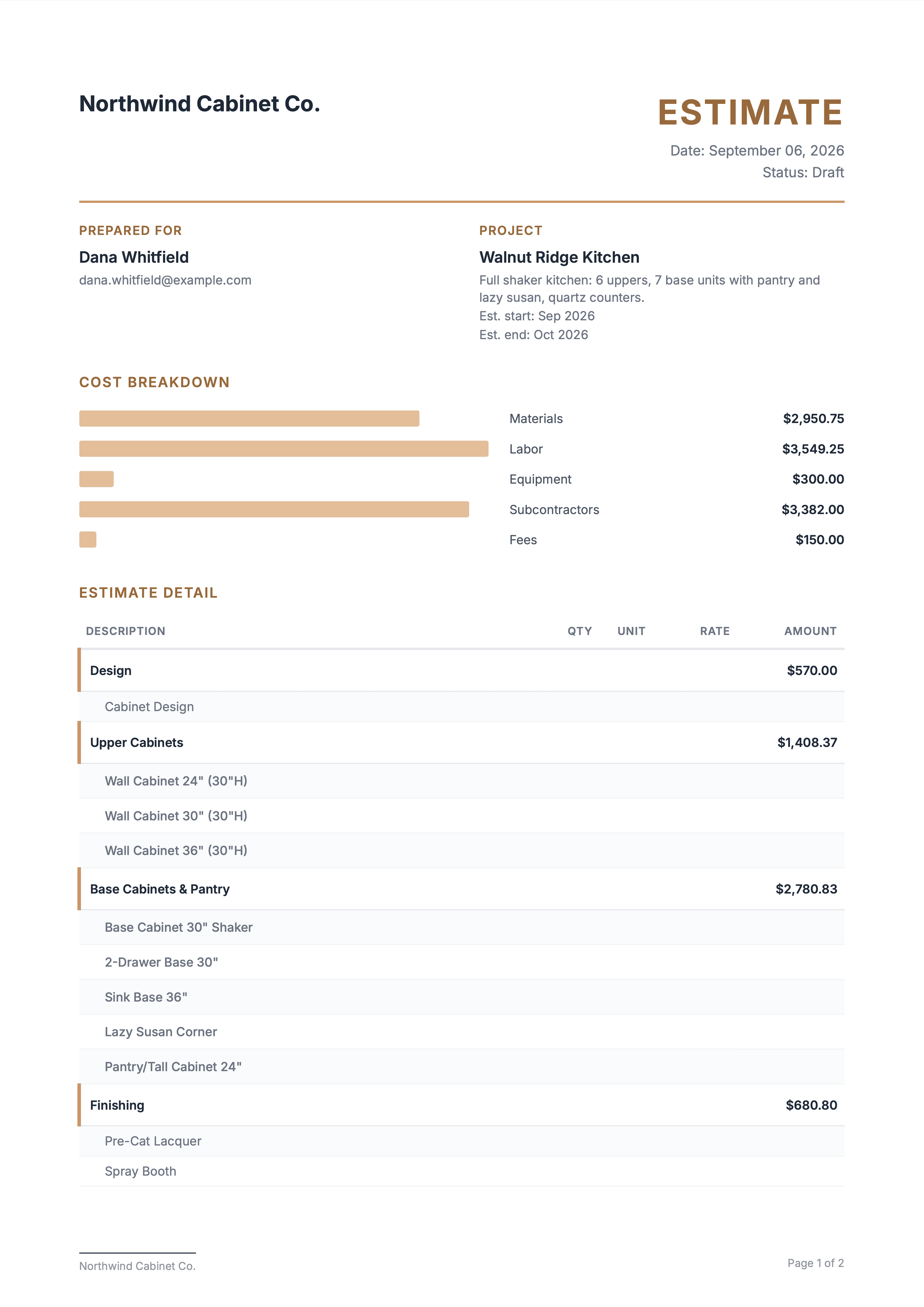
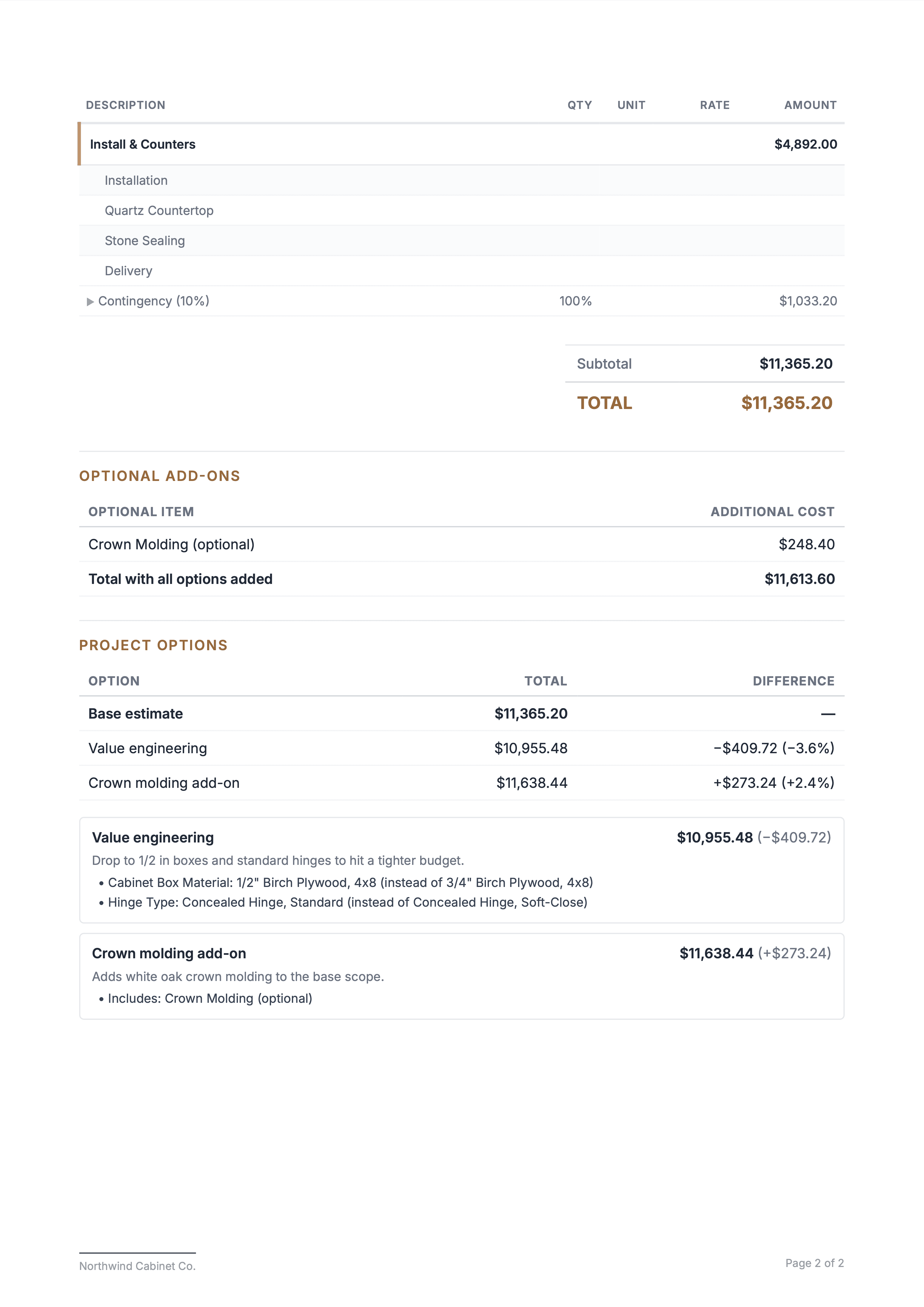
The client sees $1,408.37 for six uppers and the names of the cabinets. They don't see $62 a sheet, the 10% waste or the hinge price. The $409.72 saving and the $273.24 upgrade (the $248.40 plus its share of contingency) sit on page 2, priced, so the conversation happens with numbers on the table instead of a second week of email.
How to do it:
- Mark upgrades as optional lines. They stay out of the total and in the proposal.
- Pick the detail level on purpose: group totals for a simple kitchen, cabinet names when the client wants their list. Prices always, costs never.
- Tick the scenarios you want the client to compare. Both options go out on one document.
Your next kitchen, priced by the box
Don't rebuild all seven steps tonight. Do the two that compound.
Step 1 first: turn the cabinets you build most into assemblies, with the banding and the spray hours in the recipe. That's the evening. Then step 2: give every material a waste factor and, while you're there, a markup that isn't zero. Every kitchen after that is counts, not typing.
The rest (hours by stage, scenarios, the proposal that hides your sheet price) is there when you need it. Amberdesk is the tool this kitchen was priced in, the 30-day trial needs no card, and if you'd rather start with a number than a catalog, the cabinet pricing calculator prices a cabinet list in about a minute.
Deck builder instead? The same method, on a $11,610 cedar deck: How to estimate a deck job.
Sources
- AS Estimation, "Custom Cabinet Cost 2025" — asestimation.com (the $300–$750 per linear foot range for custom cabinets).
- Imperial Cabinets, "How to Price Custom Cabinets" — imperialcabinets.net (the factor-list format this post answers).
- All product figures: the "Walnut Ridge Kitchen" estimate in an Amberdesk demo organization, computed by the estimating engine on September 6, 2026. Realistic fixture data, not customer data.